Healthy weight for dogs: check body condition and choose the next feeding step
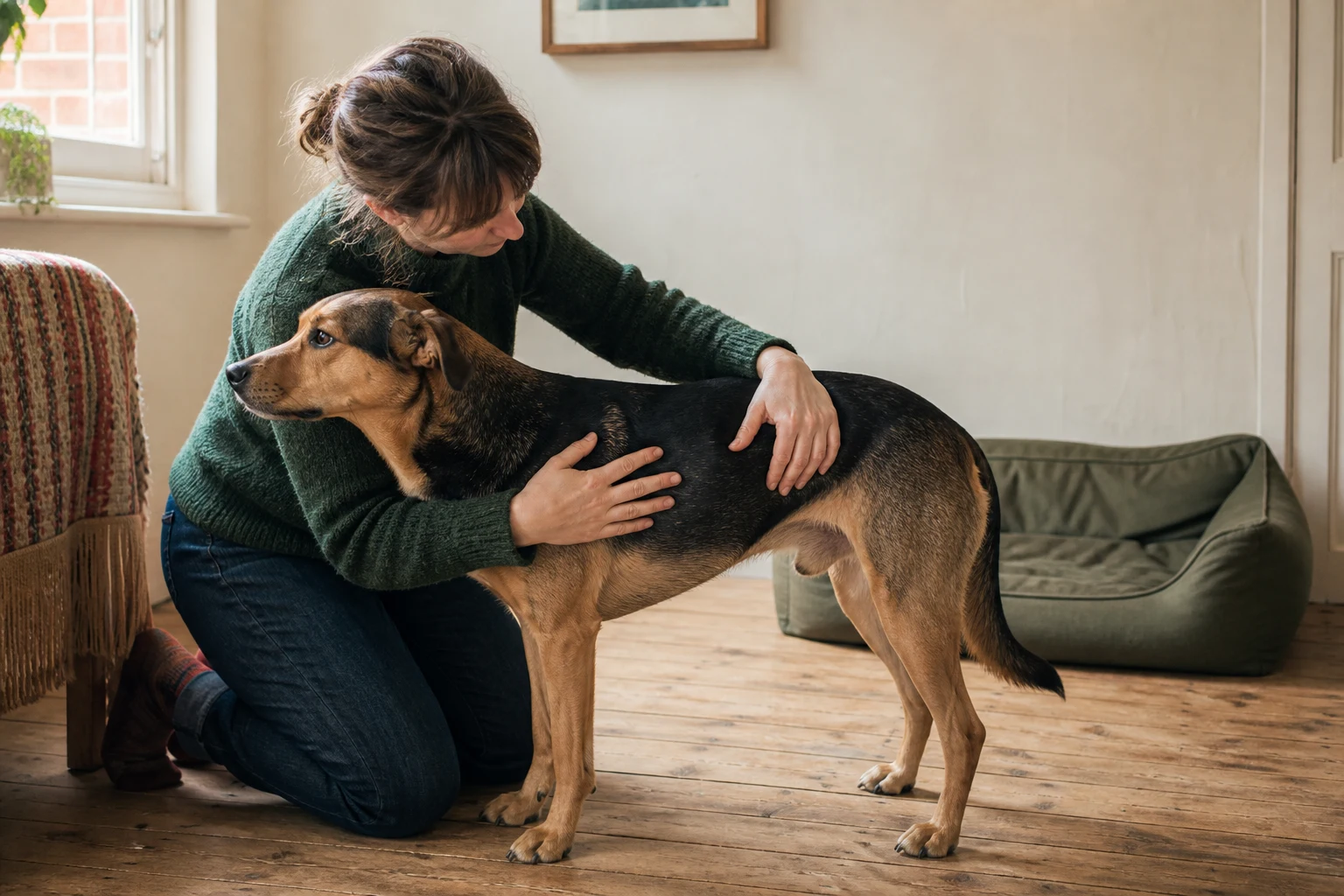
Use body condition, not a breed-weight chart alone. Look for a waist and abdominal tuck, feel the ribs, then record everything your dog eats for seven ordinary days. If your dog appears above ideal condition, the result is unclear or the change is unexplained, ask your veterinary team to confirm the assessment and set the feeding target.
This guide helps you check and prepare for that conversation. It does not diagnose obesity or prescribe calories. A photograph, a scale number and a pack feeding chart cannot set an individual plan. If the question began after surgery, use our guide to weight monitoring after neutering for the event-specific evidence and next steps.
If you are deciding whether to use a number from a calculator, start with how dog calorie calculators estimate a starting point; then return here to assess body condition rather than weight alone.
Look and feel
Check the ribs by touch, the waist from above and the abdominal tuck from the side.
If the picture is unclear, do not force a score. Ask the veterinary team.Count the whole intake
Write down meals, treats, chews, scraps, supplements, medication food and access to other bowls.
Once the daily amount is set, our dog feeding-schedule guide explains how to split that measured allowance without turning two meals into two full rations.
Use seven ordinary days. Do not change the routine to make the record look better.Choose with the vet
Above ideal condition, uncertainty and unexplained change need an individual assessment.
Puppies, pregnancy, nursing, known illness, marked excess condition, pain or breathing trouble go straight here.A general routine can sit beside the feeding plan, but it is not a weight-loss prescription. Use our guide to build a daily exercise routine around the individual dog when that is the next practical question.
How to check your dog's body condition
Body condition score, or BCS, is a standardised look-and-feel assessment of body fat. It sits beside scale weight rather than replacing it. Muscle condition score, or MCS, is separate: it assesses muscle mass over areas such as the spine, shoulders, skull and pelvis. A dog can carry excess fat and still lose muscle, particularly with age or illness.
The 2021 AAHA guideline treats 4 and 5 on the nine-point BCS scale as ideal. A score above 5 is a nutritional risk that calls for an extended assessment. The same guideline includes body weight, BCS, MCS, nutritional history and a physical examination in a complete screen (Cline and colleagues, 2021).
| Check | What to do | What you are looking for | If unclear |
|---|---|---|---|
| Ribs | Run flat fingers lightly over both sides of the ribcage. | At ideal condition the ribs are easy to feel under a light covering. You should not need to press hard. | Thick coat, loose skin or tension can mislead. Ask the vet to demonstrate. |
| Waist | Stand above your dog and look behind the ribs. | An ideal outline usually narrows towards the hips rather than continuing as one rounded shape. | Very broad chests and some conformations make this cue less obvious. |
| Tuck | Look from the side while your dog stands naturally. | The abdomen usually rises from the end of the ribs towards the hind legs. | A low stance, deep chest, coat or posture can hide the line. Do not score from one cue. |
Compare your observations with the current WSAVA body condition chart. The chart is a conversation aid, not a home diagnosis or feeding prescription.
A breed weight table answers a different question: whether a number is common for a group. It cannot show how much of one dog's weight is fat, muscle, frame or a temporary change. Adult energy references also scale with metabolic body weight rather than rising in a straight grams-per-kilogram line, one more reason a flat chart cannot prescribe an individual ration (National Research Council, 2006).
Record the whole feeding picture for seven days
A useful intake history includes more than the main bowl. The AAHA guideline specifically includes treats, table food, supplements and foods used to give medication. The point is not to catch somebody out. It is to give the veterinary team a complete starting point before they decide what, if anything, should change.
-
01Main meals
Food name, weighed or measured amount, meal times and leftovers.
-
02Treats
Training rewards, dental treats and “just one” extras from everyone in the home.
-
03Chews
Edible chews, filled toys and anything that is gradually consumed.
-
04Table food
Scraps, shared bites and food picked up from children or the floor.
-
05Supplements
Oils, powders, tablets and the edible carriers used to give them.
-
06Medication food
Cheese, meat, paste or treats used to hide tablets.
-
07Other access
Other pets' bowls, scavenging, neighbours, family members and feeding at work or daycare.
| Day | Meals and amounts | Treats, chews and extras | Notes |
|---|---|---|---|
| 1 | |||
| 2 | |||
| 3 | |||
| 4 | |||
| 5 | |||
| 6 | |||
| 7 |
Print this page if you want to write in the grid. Bring the food label, treat packets and your dog's recent weight history to the appointment as well.
Should you feed less, change food or add exercise?
Those are not three interchangeable answers. The safe sequence is assessment, an agreed feeding plan and monitoring. A veterinarian may adjust the amount of the current food, choose a different food, change how extras are used, or investigate a medical reason for the weight change. The decision depends on body and muscle condition, current intake, life stage, health, diet energy density and how the dog responds over time.
Where significant calorie restriction is needed, the AAHA guideline recommends a purpose-formulated, nutrient-fortified therapeutic weight-loss diet. That protects nutrient intake while energy is restricted. It does not mean every dog above ideal condition needs a prescription food, and it does not make “light”, low-fat, high-protein or high-fibre wording a universal answer. If a new food is chosen, use the established guide to switch your dog's food gradually.
Activity can support mobility, enrichment, routine and the wider plan, but a generic exercise schedule is not safe for every dog. Pain, breathing difficulty, age, fitness and medical conditions change what is appropriate. Ask the veterinary team what movement is suitable rather than trying to outrun an unknown feeding surplus.
If your otherwise healthy adult dog is doing more physical work and you are unsure whether the bowl should change, use our guide to feeding an active dog. It starts with workload, weighed intake, weight trend and body condition rather than a blanket percentage.
Bring
- Your seven-day whole-intake record
- Current food and treat labels
- Recent weights and dates, if available
- Body-condition observations, including what was unclear
- Medication, supplement and activity details
Ask
- What are my dog's BCS and MCS?
- Is the weight change expected or does it need investigation?
- What exact food and daily amount should we start with?
- How should treats and medication food fit?
- When and how will we review progress?
What the evidence can and cannot tell us
Assess fat, muscle and the whole intake
AAHA puts BCS, MCS, weight, diet history and examination together, then recommends an individual plan.
Read the guidelineOne lifelong Labrador comparison
In 48 research-colony Labradors, the lower-allocation group had a longer median lifespan and generally later chronic-disease signs.
Read Kealy and colleagues, 2002A fixed ration cut is not the result
The Labrador study paired dogs from puppyhood and compared one fixed allocation with its pair-mate. It was not a DIY weight-loss trial in overweight pets.
No percentage cut transfers to your dog.The study does not prove that excess condition caused any named disease, or that weight loss treats one. It also cannot promise the same lifespan result for every breed or pet home. Its useful message is narrower: long-term feeding allocation and condition matter enough to deserve an individual, monitored plan.
Life stage and condition-specific routes
Frequently asked questions
How can I tell if my dog is overweight?
Use several observations together: feel the ribs, look for a waist from above and an abdominal tuck from the side, then compare them with a recognised body-condition chart. Coat, conformation and posture can make the answer unclear. Ask your veterinary team to confirm the score rather than diagnosing from a photograph or scale number alone.
What body condition score should a dog have?
The 2021 AAHA guideline treats 4 and 5 on the nine-point scale as ideal. A score above 5 is a nutritional risk that warrants extended assessment. Body condition describes fat stores; muscle condition is assessed separately and matters even when a dog is carrying excess fat.
Should I just feed my overweight dog less?
Do not make a percentage cut from a pack chart or current ration without an individual plan. The safe amount depends on body and muscle condition, current intake, life stage, health, diet energy density and monitoring. Record the whole intake and ask the veterinary team to set the starting amount.
What food is best for an overweight dog?
There is no universal best format. The right choice follows the nutritional assessment. Some dogs can use an adjusted amount of their current complete food; significant restriction may call for a purpose-formulated, nutrient-fortified therapeutic weight-loss diet. Front-of-pack words such as light, low-fat or high-fibre do not make that decision by themselves.
Will more exercise help my dog lose weight?
Suitable activity can support the wider plan, but no generic schedule is safe for every dog. Pain, breathing difficulty, age, fitness and medical conditions change what is appropriate. Ask the veterinary team what movement fits your dog and address food intake rather than trying to compensate for an unknown surplus.
When should I see a vet about my dog's weight?
Book an assessment when your dog appears above ideal condition, the home check is unclear or the change is unexplained. Go before changing food for puppies, pregnant or nursing dogs, dogs with known disease, marked excess condition, pain or breathing difficulty, and any rapid or unexplained weight gain or loss.
Sources and scope: The assessment and feeding boundaries use the locked 2021 AAHA guideline, DOI 10.5326/JAAHA-MS-7232. The metabolic-weight principle comes from the National Research Council reference, DOI 10.17226/10668. The bounded lifespan paragraph uses the 48-Labrador paired study by Kealy and colleagues, DOI 10.2460/javma.2002.220.1315. This guide publishes no calorie target, ration cut, weight-loss rate, exercise dose or Some Grub product recommendation.
If you already have a weight-management plan and are comparing foods, use our weight-loss food choice guide to keep the label decision separate from body-condition assessment.