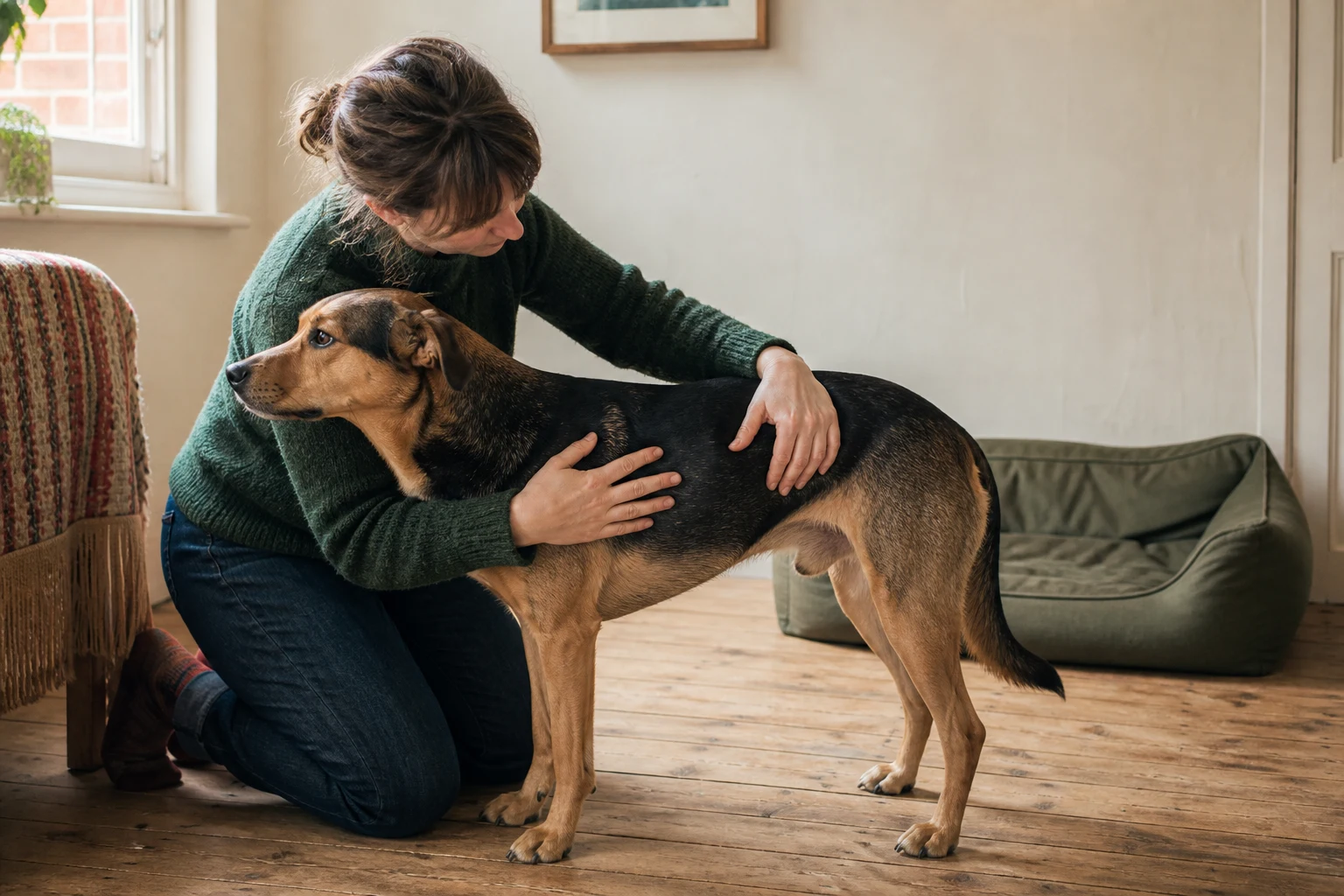
Large-breed puppy feeding: how much matters most
If you have a large-breed puppy, you have probably been told to avoid high-protein food because it makes them grow too fast and damages their joints. That belief has been tested directly, and it points at the wrong nutrient.
In a two-year controlled trial, 48 Labrador Retrievers were split into two groups from eight weeks old. Both ate the identical food. One group was fed freely; the other was given 25% less than the free-fed group ate. At two years, hip dysplasia had developed in 7 of 24 limit-fed dogs and 16 of 24 of those fed freely.
Same food. The difference was how much of it went in the bowl.
Some Grub makes insect-protein food and treats for adult dogs. We do not make a puppy food, and a growing large-breed puppy needs a diet formulated for growth. There is no version of this page that ends with us selling you something.
When you are deciding whether growth food is still needed, use our puppy-to-adult food readiness guide before starting the change.
the short version
- The variable that changed outcomes was how much food, not its protein content.
- 25% less than free feeding is not 25% less than your puppy needs. Free feeding is itself the excess. Do not cut a correct portion.
- Protein was tested separately at matched calories and has not been shown to affect skeletal development. If anything the evidence points the other way: in the same Great Dane cohort, the lowest protein level tested was described as marginal, though those effects were slight.
- Calcium excess is evidenced harm. In Great Danes, high calcium produced rickets-like disease, and osteochondrotic lesions appeared even after the diet was corrected.
- Watch body condition and rate of growth, not a percentage on the bag.
Read this before you change anything. In that trial, "25% less" means 25% less than dogs eating as much as they wanted. The free-fed group was the over-fed one. The limit-fed group was eating an appropriate amount, not a restricted one.
So the change the evidence supports is stop free feeding and start measuring set meals. It is not "feed less than the guidance". Taking a correct, measured portion and cutting a quarter off it means underfeeding a growing animal, which does its own harm.
If you are not sure whether your puppy is on track, ask your vet to assess body condition and weigh them on the same scales each visit. That is a better instrument than any number on a pack.
ring your vet if
Your puppy limps, goes stiff after rest or exercise, becomes reluctant to walk, run or use stairs, sits or moves oddly, or seems sore when handled around the hips, elbows or shoulders. The conditions described on this page are diagnosed and managed by a vet, growth problems are easier to help early, and feeding changes are not the answer to a limping puppy.
How many meals? Most large-breed puppies do well on three or four measured meals a day at eight to twelve weeks, dropping to two or three as they grow. Follow the guidance on your food and your vet's advice for your dog. The point is that the food is measured and finite, not that it is spread over any particular number of sittings.
What the Three Trials Actually Show
Three studies carry the weight, and they tested different things. That is the point.
| Study | Design and size | What it shows | What it does not show |
|---|---|---|---|
| Kealy and colleagues, 1992 | Controlled trial, 48 Labradors from 8 weeks to 2 years, identical food, one group fed 25% less than free-fed | Hip dysplasia in 7 of 24 limit-fed versus 16 of 24 free-fed by OFA scoring, and 5 of 24 versus 18 of 24 by the Swedish method. Intake changed the outcome on two independent scoring systems | Nothing about protein, which was not a variable. Labradors only. And not a licence to cut a correct ration by a quarter |
| Nap and colleagues, 1991 | Controlled study, 17 Great Dane pups, 14.6% to 31.6% protein on a dry-matter basis, calories deliberately matched | Across that whole range, protein level had no effect on skeletal development | With 17 pups and one direct test, protein has not been shown to cause the problem. Not proof it never could. Says nothing about calcium or energy |
| Schoenmakers and colleagues, 2000 | Controlled feeding study in growing Great Danes, control versus high calcium and high calcium-plus-phosphorus, with radiographic, histological and biochemical endpoints | High calcium without matching phosphorus produced hypercalcaemia and severe skeletal disturbance typical of rickets. After calcium was normalised the rickets resolved, but osteochondrotic lesions then appeared | A safe upper limit or any figure for a UK pack. It shows excess harms; it does not tell you a target |
Quantity. Forty-eight Labradors, one bag, two years, one group given less than the others chose to eat. Hip dysplasia roughly halved, and the effect held whether scored by the OFA method or the Swedish one. Because the diet was identical in every other respect, the finding points at intake rather than any ingredient. Read the Kealy trial.
Protein. If protein drove skeletal problems, feeding more at the same calorie intake should show it. Seventeen Great Dane pups were fed 14.6% to 31.6% protein on a dry-matter basis with calories held level, and skeletal development did not differ. Read the Great Dane protein study.
One trial with seventeen pups is not a closed question, so the honest phrasing is that protein has not been shown to cause developmental orthopaedic disease. But it is a direct test of the belief, and it did not find what the belief predicts.
Worth knowing, because it points the opposite way: a companion study on the same 17 pups concluded that the bottom of that range, 14.6% on a dry-matter basis, was "marginal" for Great Dane pups between 7 and 17 weeks. The effects behind that were slight, if statistically significant, and it is one small study in one breed across a narrow age window. Take it as a reason not to go hunting for the lowest-protein bag on the shelf, rather than as a minimum for every puppy. Read the companion study.
Calcium. This is where an owner can cause harm without meaning to. Great Danes fed high calcium developed rickets-like skeletal disease. When the diet was corrected, the rickets resolved, but osteochondrotic lesions then became apparent, and in the high calcium-and-phosphorus group the disturbances had only partly resolved ten weeks later. Read the calcium study.
The practical lesson is that this is a problem to prevent rather than fix. A complete puppy food is already formulated with the minerals a growing dog needs, so adding a calcium supplement on top is not a harmless extra. Ask your vet before you add anything.
What to Watch Instead of a Percentage
Measured meals, not a full bowl
Weigh or measure the portion and feed set meals. This is the single change the evidence most directly supports, and it costs nothing.
Body condition, not weight alone
A big puppy is not necessarily an over-fed one, and the scales alone will not tell you. Ask your vet to show you how to score body condition, then check it yourself every couple of weeks.
Rate of growth, not final size
Feeding more does not make a dog bigger as an adult, it makes them get there faster. Adult size is largely genetic; growth rate is the part the bowl controls.
A food built for growth
Large-breed puppy formulas exist because growth has specific requirements, including how calcium is balanced. Ours is an adult food and is not one of them.
The Limits of What We Have Told You
The quantity trial was Labradors. The large-breed principle is widely accepted, but it was not tested across every breed. The protein study is one trial with seventeen pups, which is why we say protein has not been shown to be the problem rather than treating the question as settled. The calcium study is a small, single-breed study too, and it shows that excess causes harm without telling anyone what a safe ceiling is, which is precisely why we are not giving you a number.
What all three share is that they are about growth, a window that closes. None of this transfers to an adult dog.
Frequently Asked Questions
Is high-protein food bad for large-breed puppies?
It has not been shown to be. Great Dane pups fed 14.6% to 31.6% protein on a dry-matter basis, with calories matched, showed no difference in skeletal development. A companion study on the same 17 pups concluded that the low end, 14.6%, was marginal for that breed between 7 and 17 weeks, on slight though statistically significant effects. So if protein matters in a big puppy, the evidence points at too little rather than too much. The variable that did change outcomes in a separate trial was how much food was eaten.
How much should I feed my large-breed puppy?
Start from the feeding guidance on a food formulated for large-breed growth, serve it as measured meals rather than leaving a bowl down, and adjust with your vet based on body condition and growth rate. Do not cut below the guidance on the strength of the 25% figure in the trial: that comparison was against dogs eating as much as they wanted, not against a correct portion. Underfeeding a growing puppy causes its own harm.
Does feeding less make my puppy smaller?
Adult size is largely genetic. What intake changes is how fast a puppy gets there. In the Labrador trial the limit-fed group reached two years with substantially less hip dysplasia.
Should I give my large-breed puppy a calcium supplement?
Ask your vet first, and expect the answer to be no if your puppy is on a complete puppy food. In growing Great Danes, high calcium produced rickets-like skeletal disease, and osteochondrotic lesions appeared even after the diet was corrected. Complete puppy foods are already formulated with the minerals growth needs.
Can I feed adult food to a large-breed puppy?
No. Growth has requirements an adult formula is not built to meet, including how calcium and phosphorus are balanced. Our own food is an adult formula and is not suitable for this job.
Does Some Grub make a puppy food?
No. We make insect-protein food and treats for adult dogs. A large-breed puppy should be on a diet formulated for growth.
Related Reading
This guide is general information, not a diagnosis or a substitute for veterinary advice. Growing puppies change quickly, and portion and supplement decisions belong with the vet who can weigh and examine yours.
Last updated: 5 August 2026
picked for this page
Where to go next

A useful next step · 25 min read
Novel Protein Dog Food: The Real Science Explained
What actually makes a protein novel, why it only works if your dog has never eaten it, and how venison, duck, kangaroo and insect really compare.
Read the guide